

Remember blowing on a Super Mario cartridge and wiggling it until the game finally worked?
It was kinda fun as a kid (and weirdly effective), but if that’s become your “fix” for your office phone system issues. . . that’s not fun. That means you’re dealing with a problem.
So, if you’ve ever had to:
- Unplug the whole system and plug it back in
- Wiggle the wires until the line stops buzzing
- Smack the desk in just the right spot for the hold button to work again
. . .it’s time to let the ‘90s go. Don’t worry, though – you’ll be in good company. Across Victoria and the surrounding South Texas region, business owners are realizing their old phone setups just aren’t cutting it anymore.
The good news? All y’all have better options.
This guide will address everything you need to know about commercial phone systems, including crucial topics like:
- What types of systems are out there (and which ones are fading fast),
- Why VoIP for small businesses is taking off in South Texas,
- And how to choose a provider that doesn’t leave you hanging when something breaks.
If you’re thinking about upgrading your phones, start here.
What Are Commercial Phone Systems, Exactly?
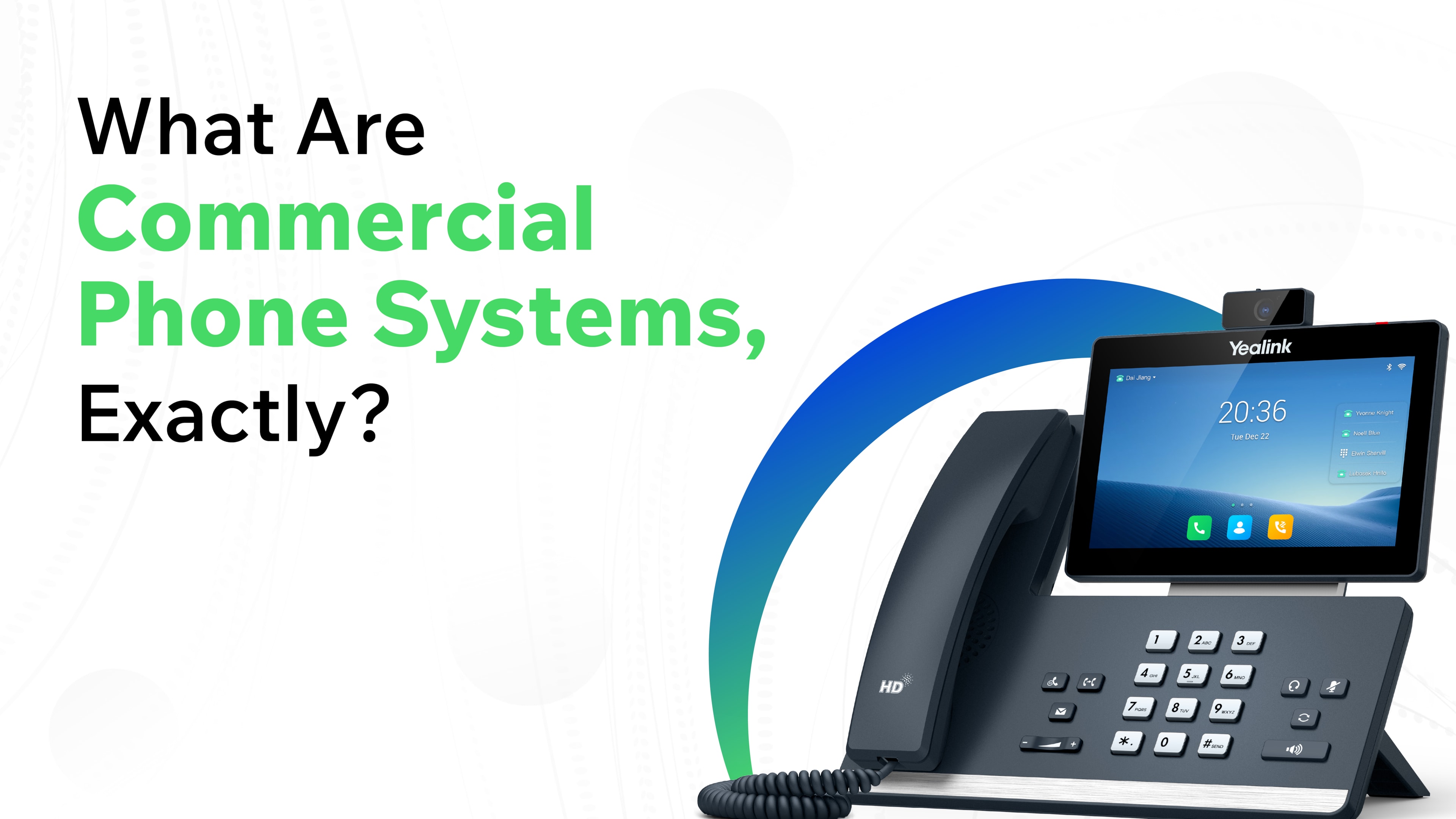
Let’s start with a basic definition. A commercial phone system is just a setup designed specifically for business use. That means it can do a lot more for business productivity than a typical home setup or even a basic plug-and-play line from the local phone company.
Here’s the difference in plain terms:
| Home or Basic Phone Setup | Commercial Phone System |
|---|---|
| One or two lines | Dozens of lines and extensions |
| Answering machine or personal voicemail | Business-grade voicemail with custom greetings |
| Caller ID, maybe call waiting | Call routing, call queues, hold music, call recording, and auto-attendant |
| One phone number for everything | Direct lines for departments or employees |
| One-size-fits-all | Customized for how your business operations actually work |
In summary: a true commercial phone system doesn’t just ring. It routes, greets, records, forwards, and keeps your team connected right from the jump.
Now, let’s look at the actual types of systems out there so you can see what’s worth your time (and what’s headed for retirement).
The 4 Main Types of Commercial Phone Systems: A Quick Comparison
There are a few main types you’ll run into:
| System Type | How It Works | Best For | Common Drawbacks |
|---|---|---|---|
| Traditional Landline (PSTN) | Uses copper phone lines via a local telephone company. | Offices with very basic needs or no internet access. | Expensive, outdated, and limited flexibility. |
| PBX (Private Branch Exchange) | On-site phone hardware that routes calls internally and externally. | Larger offices with in-house IT teams. | Costly to install and maintain. Not very flexible. |
| VoIP (Voice over Internet Protocol) | Sends calls over the internet instead of traditional lines. | Most small-to-mid-sized businesses. | Needs stable business internet (which is easier than ever in Victoria). |
| Hosted VoIP (Cloud-Based) | A type of VoIP managed by a provider, no hardware needed on-site. | Businesses that want flexibility, scalability, and remote features. | May rely on provider support, so choose carefully (we’ve heard eTech’s pretty rad). |
More and more business owners in Victoria and around South Texas are trading out their old setups for something that works better, costs less, and makes life easier.
That something is VoIP.
Still guessing at the right phone setup? Don’t. Our step-by-step guide makes it easy to find your perfect fit.
Why More Victoria Businesses Are Choosing VoIP

Making the switch from an old-school landline to a VoIP system might seem like a big change, especially if you’ve had the same setup for years. However, once you look at how VoIP works (and what it delivers), it’s easy to see why it’s gaining traction across South Texas today.
A Quick Review of VoIP
Instead of sending your voice through a traditional phone company’s wires, VoIP-based commercial phone systems convert it into a digital signal using Voice over Internet Protocol technology and send it over your internet connection.
If your business currently has reliable internet service (which most do), you already have the backbone needed for a VoIP setup. All you need is a provider.
The Biggest Benefits Small Businesses Get with VoIP
Now that we’ve covered how VoIP systems work, let’s talk about what they deliver.
1. Cost Savings That Stick
Landlines often come with expensive installation fees, long-distance charges, and constant upkeep. With VoIP, most of those costs vanish. Calls (even long-distance ones) are bundled into a flat monthly rate. For businesses trying to save money and stretch their budget, this is one of the biggest advantages.
2. Flexibility for Growing Teams
Adding a new employee with a landline setup often means running new wiring or buying extra hardware. With VoIP, it’s as simple as adding a user through your provider. Whether you’re hiring a new receptionist at a doctor’s office or bringing in another associate for your retail store, this seamless communication system grows with you.
3. Built-In Features That Solve Everyday Problems
VoIP systems come loaded with tools designed for real-world business challenges:
- Voicemail-to-email means a missed call at your Main Street shop shows up right in your inbox.
- Auto-attendants route calls to the right department, which is a lifesaver for busy clinics or schools.
- Mobile forwarding lets you take calls on the go, whether you’re out meeting clients or managing a job site.
- Call recording makes training, documentation, and customer follow-up a whole lot easier.
- Call queues and ring groups spread calls across your team ensuring your customers spend less time waiting during rush hours.
When you combine features like these, your phones stop being a hassle and start pulling their weight.
4. Better Uptime and Reliability
Some business owners worry: what if the internet goes down? Many VoIP systems include failover features that automatically route calls to a mobile phone or backup line. That means fewer missed opportunities and happier customers.
5. Scalability Beyond Victoria
For local businesses with multiple locations (maybe one in Victoria and another in Corpus or San Antonio), VoIP commercial phone systems make it easy to link everything under one system. Your team can transfer calls across cities as easily as if they were down the hall.
That’s not all, either. To dive deeper into the benefits of South Texas VoIP systems, check out our blog on the subject!
Put it all together, and you’ve got a phone system that costs less, does more, and actually fits the way Victoria businesses work. Honestly. . . what’s not to like?
The Real-World Impact: VoIP + Auto Repair Shop
To give you a fuller picture of how these benefits can help a small business, picture a busy auto repair shop off Navarro Street.
The phones are ringing, technicians are hollering over air tools, and customers are dropping off cars and calling in for updates. Before switching to VoIP, the front desk was overwhelmed. Calls were piling up, messages got lost on sticky notes, and customers were getting frustrated.
After moving to a commercial VoIP phone system, everything changed. Calls route straight to the right person instead of bouncing around. If the front desk is swamped, voicemails land in email so the manager can return them between customers. When a technician steps out for a test drive, they can still answer the shop’s main line on their mobile.
What used to be a headache at the front desk is now one of the shop’s most useful tools. That’s the kind of everyday impact a good VoIP system can make.
What Questions to Ask a Victoria TX Commercial Phone Provider

Choosing the right commercial phone provider isn’t just about who offers the cheapest plan. It’s about who understands how businesses actually run in this part of Texas.
When evaluating providers, ask:
- “Where is your support team based? Will someone local show up if my phones go down?”
A provider with technicians in Victoria or South Texas can respond quickly. If they only offer remote help from a big-city call center, you may be waiting while customers get frustrated. - “Have you worked with businesses like mine in Victoria?”
A boutique on Main Street, a restaurant off the Loop, or a small clinic near DeTar all have different communication needs. A good provider should be able to give examples of how they’ve helped similar local businesses. - “How reliable is your service during South Texas internet slowdowns or outages?”
Clear, reliable call quality is nonnegotiable. Ask if they prioritize voice traffic and what kind of uptime they can guarantee in this region. - “Can your system grow if I open another location in Cuero, Goliad, or Corpus?”
Many Victoria businesses experience success and eventually expand to nearby towns. Make sure the phone system can scale without expensive overhauls, so your teams can continue to collaborate with confidence. - “Do you also handle internet, cabling, or IT, or will I be juggling multiple vendors?”
For most small and mid-sized businesses, it’s simpler (and cheaper) to have one local technology partner managing everything. That leads to less finger-pointing and faster fixes.
Speaking of one local technology partner. . .
Here’s What You Get When You Choose eTech

eTech has been helping businesses across South Texas improve their technology for years (ask around, and someone’s probably got an “eTech fixed it” story). When things go sideways or it’s time to upgrade, we’re the ones local teams call.
So what does that look like when it comes to commercial phone systems? Here’s what you can expect:
- Custom-fit VoIP solutions: We leave the cookie cutters in the kitchen where they belong. Instead, we offer competitive pricing when we build setups that fit your team, your building, and help you focus on your long-term goals.
- Ongoing support: Our team is right here in Victoria. If something goes wrong, you’re not dialing a 1-800 number for assistance, you’re calling a crew that knows you and your system and can help you right away.
- No vendor juggling: We also handle your internet connectivity, structured cabling, IT support, and more. That means you get the advantage of one point of contact.
Your phones should help your business, not drive you nuts. That’s why we build clean, reliable systems that stay out of your way and just do their job (the way it should be). So don’t wait – let’s get your phones sorted today.


